
LV Switchgear Types: MNS, GGD, GCS and GCK, and Where KYN Fits
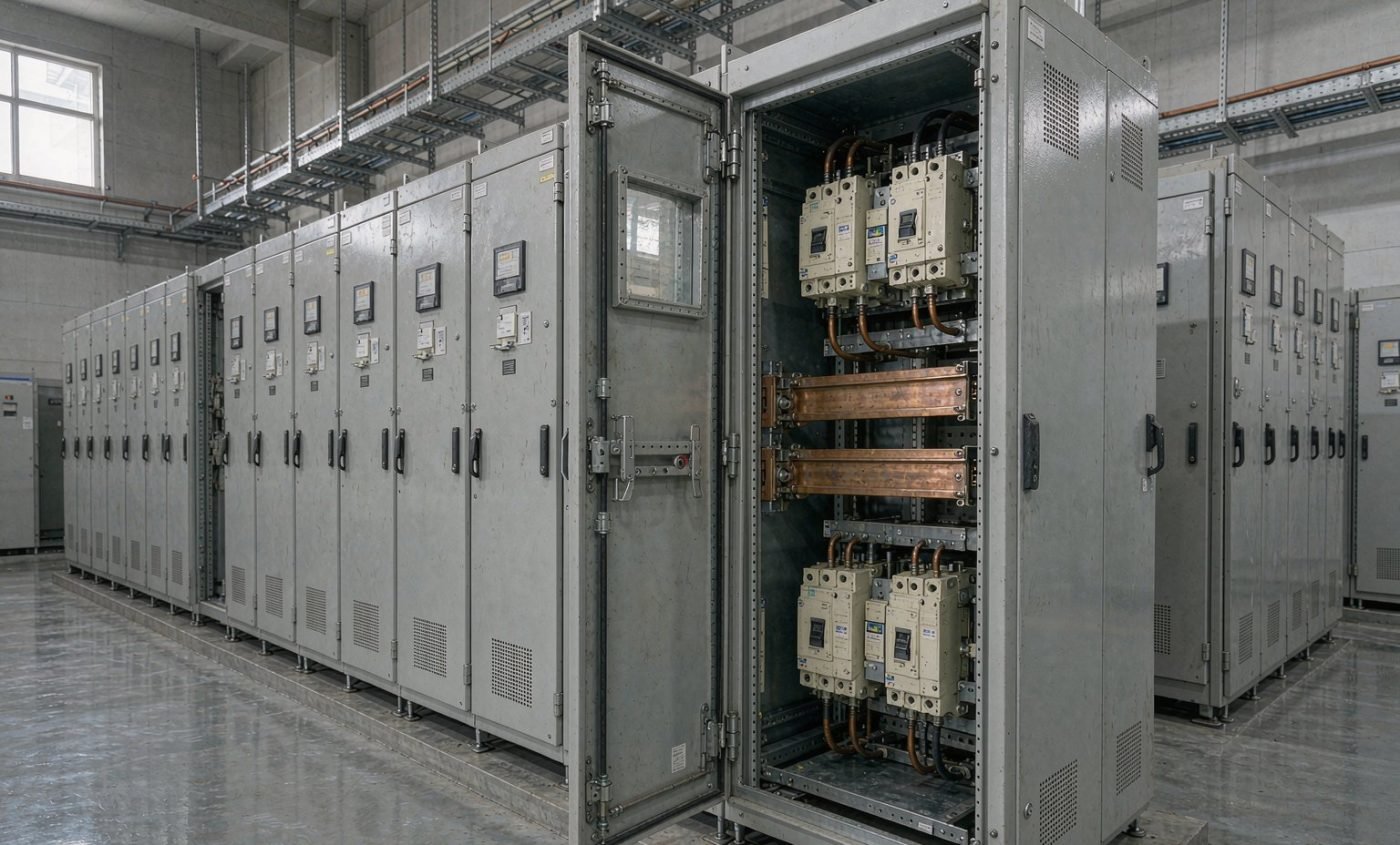
The question usually arrives as one list: KYN, MNS, GGD, GCS and GCK, which one should we specify? The honest answer is that the list is not one comparison. Four of those names are low voltage assemblies and one is medium voltage metal-clad switchgear, and no amount of price comparison will line them up.
Sorting the names into the right voltage class first, then choosing between fixed and withdrawable construction, then reading the form of separation, answers most of the question before any quotation is opened.
The list mixes two voltage classes
KYN is a medium voltage metal-clad design, normally built for 12 kV or 24 kV, with a withdrawable truck that carries the circuit breaker. It sits in front of the transformer, not after it, and it is assessed against the metal-enclosed switchgear and controlgear standard rather than the low voltage assembly standard.
MNS, GGD, GCS and GCK are all low voltage assemblies at 400 V or 690 V. They sit after the transformer and distribute to loads. If a specification lists them together, the drawing is asking for two different boards and the enquiry should be split: MV switchgear on one line, LV switchgear on the other.
Fixed type GGD: the panel that does not move
GGD is a fixed type low voltage panel: the breakers are bolted in place behind a door, the busbar runs along the top or the back, and cables land on terminals at the bottom. There is no withdrawable drawer and no compartment per feeder, so the panel is shallow, cheap and quick to build.
Its natural home is a board with few outgoing ways, or a board where the load does not need to be restored in seconds. Changing a breaker means isolating the section and working on it in place. In a plant with a maintenance team and a planned shutdown window, that is entirely acceptable. In a continuous process, it is not.
Withdrawable MNS, GCS and GCK
These three are compartmented assemblies with a withdrawable module per feeder. The breaker sits in a drawer that racks out, so a failed device is replaced by a spare without touching the busbar or the adjacent feeders. That is the reason they exist, and it is the reason they cost more than a GGD of the same rating.
The names come from different places. MNS is a modular system design, originally European, built under licence by a number of manufacturers, with a fixed module grid that makes the compartments interchangeable. GCS and GCK are Chinese low voltage withdrawable types, widely specified on projects designed in China and on export projects following a Chinese EPC contractor’s standard, with GCK more often used for motor control centres and GCS for distribution.
Practically the three overlap. Ask which one the local maintenance team can buy spare drawers for, and which one the consulting engineer’s standard specification names. A drawer that cannot be replaced locally turns a withdrawable board into a fixed one with extra steps.
Form of separation decides more than the type name
Within any of these families the enclosure can be built to different forms of separation, and that choice changes the price more than the family name does. The forms run from no internal separation at all, through separation of busbars from functional units, to full separation of every functional unit with its own terminals.
| Form | What is separated | Typical use |
|---|---|---|
| Form 1 | Nothing internally | Simple distribution, low fault level |
| Form 2 | Busbars separated from functional units | General distribution boards |
| Form 3 | Busbars separated, units separated from each other | Plant distribution with several feeds |
| Form 4 | Busbars, units and terminals all separated | Continuous process, live maintenance |
Form 4 is what most buyers actually want when they say they need a withdrawable board, because the point of a drawer is to work on one feeder while the rest stays live. Form 2 in a withdrawable enclosure gives the drawer without the safety, which is the most common mismatch we see in specifications.
Sizing the incomer from the transformer
The board is sized from two numbers, and both come from the transformer rather than from the load list. The first is the rated current:
I = S / (√3 × V). A 1,600 kVA transformer at 400 V carries 1,600,000 / (1.732 × 400) = 2,309 A, so the incomer is a 2,500 A frame device and the busbar is rated above it.
The second is the prospective short-circuit current, which sets the breaking capacity of every device on the board: Iₛₛ = I × 100 / Z%, with Z% the transformer impedance. At 6 per cent, 2,309 × 100 / 6 = 38,500 A, so the assembly is specified for a prospective fault around 38.5 kA rather than for a round number picked from a catalogue.
Both figures change if the transformer changes, which is why the switchgear cannot be ordered before the transformer is fixed. On a project where the LV board is bought first, the impedance is usually assumed, and the assumption is either expensive or unsafe.
What to put in the enquiry
- Transformer rating, impedance and LV voltage, so the current and fault level can be calculated
- Single line diagram showing incomer, busbar rating and outgoing ways
- Fixed or withdrawable, and the form of separation required
- Whether the board is distribution or motor control, and the starter types if it is MCC
- Metering, power factor correction and any ATS or generator incomer
- IP rating, cable entry direction and the space available in the room
- The standard the project cites, and any national type the local inspector expects
Standard delivery is 30 days and the warranty is 2 years. If the assembly goes inside a compact substation, send the enclosure drawing with the enquiry as well, because the LV compartment depth limits how many ways fit. The LV switchgear panels we build cover the MNS, GGD, GCS and GCK families, and the MV switchgear panels cover the KYN class that sits on the other side of the transformer. Where both boards arrive in one enclosure, see the compact substation range and the enclosure comparison; for relay settings on the incomer, transformer protection covers the coordination step.
Questions buyers ask
Is KYN a low voltage switchgear type?
No. KYN is medium voltage metal-clad switchgear, normally 12 kV or 24 kV, with a withdrawable truck carrying the circuit breaker. It is installed on the MV side of the transformer. MNS, GGD, GCS and GCK are the low voltage types, installed on the LV side.
What is the difference between GGD and GCS?
GGD is a fixed type panel: breakers are bolted in place, with no drawer and no compartment per feeder. GCS is a withdrawable, compartmented assembly, so a failed breaker can be racked out and replaced while the rest of the board stays live. GGD is cheaper and simpler; GCS is faster to restore.
MNS, GCS or GCK, which should I specify?
Whichever the local maintenance team can get spare drawers for and the project’s standard specification names. The three overlap technically. A withdrawable board with no local spare supply behaves like a fixed board with extra steps, which is a procurement problem rather than an engineering one.
How do I size the main incomer?
From the transformer, not the load list. Rated current is I = S / (√3 × V), so a 1,600 kVA unit at 400 V gives 2,309 A and a 2,500 A frame incomer. The breaking capacity comes from the prospective fault current, Isc = I × 100 / Z%, which at 6 per cent impedance is about 38.5 kA.
Does the form of separation affect the price much?
It is often the largest single driver inside one family, because each step adds barriers, separate terminal zones and more assembly time. A withdrawable assembly built to a low form gives the appearance of maintainability without the separation that makes live work safe, so the form should be stated explicitly rather than left to the supplier.
Send us the specification
Rating, primary and secondary voltage, frequency, quantity and the application. We answer within one working day.
Email info@xsdfftransformer.com · WhatsApp +852 54162620